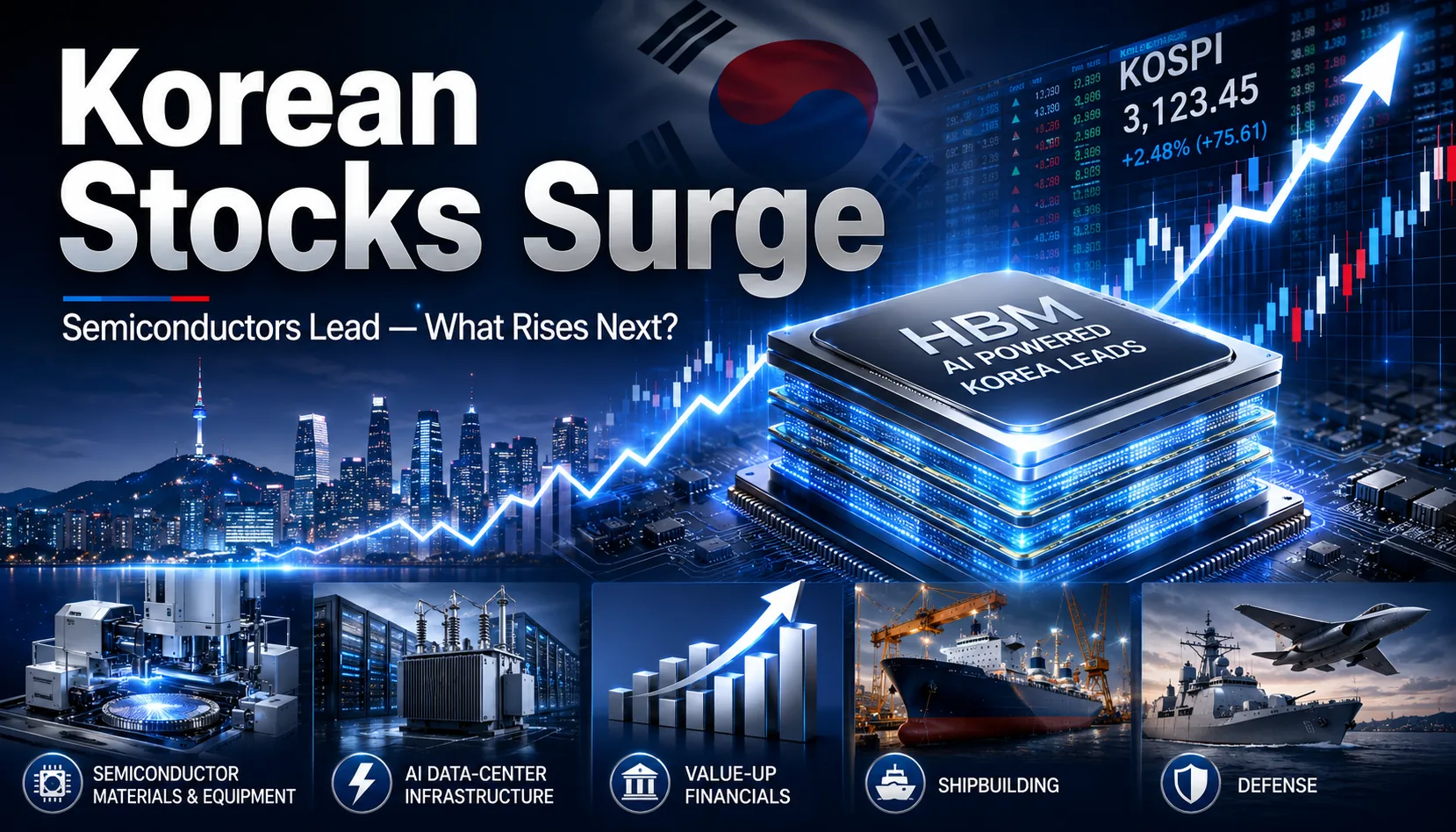
Why Korean Stocks and Semiconductor Shares Are Surging — and the Sectors That Could Follow
As of May 28, 2026, South Korea’s equity rally is mostly an AI-memory story, but not only an AI-memory story. The strongest next opportunities are likely to sit around the bottlenecks that the chip boom creates: advanced packaging, semiconductor materials and equipment, data-center power infrastructure, AI storage, shareholder-return beneficiaries, and selected shipbuilding and defense names.
This article is general market analysis for global readers. It is not personalized investment advice, a recommendation to buy or sell any security, or a forecast guarantee.
South Korea has suddenly become one of the cleanest public-market expressions of the AI infrastructure boom. The reason is simple: AI needs compute, compute needs memory bandwidth, and Korea is home to two of the world’s most important memory companies, Samsung Electronics and SK hynix.
But the more useful question is not “Why did Korean chip stocks go up?” That part is now obvious. The better question is: which parts of the Korean market still have room to be revalued if the AI capex cycle keeps spreading beyond GPUs and memory?
The answer is not “everything related to semiconductors.” It is more selective than that.
The rally in one paragraph
Reuters reported on May 27, 2026 that SK hynix crossed $1 trillion in market value for the first time, after Samsung Electronics had passed the same milestone earlier in the month. The KOSPI also hit a record high, with Samsung and SK hynix accounting for roughly half of the index by market capitalization. Reuters also reported that the KOSPI had risen 95% so far in 2026, after a 76% gain in 2025. [Reuters, May 27, 2026]
That is not a normal broad-market move. It is a concentrated re-rating of Korea’s role in the AI supply chain.
A few weeks earlier, on May 6, Reuters reported that the KOSPI had broken above 7,000 for the first time, with Samsung and SK hynix together accounting for 44% of the index’s total value. Foreign investors bought a record 3.1 trillion won of local shares that day, according to the same report. [Reuters, May 6, 2026]
For global investors, that gives the Korean market a double identity. It is a national equity market, but it is also a high-beta AI infrastructure instrument.
Why Korean semiconductor stocks are rising
1. AI moved from narrative to financial statements
The first leg of the rally was narrative: generative AI, data centers, accelerators, and high-bandwidth memory. The second leg is harder to dismiss because it has appeared in earnings.
Samsung Electronics reported first-quarter 2026 consolidated revenue of 133.9 trillion won and operating profit of 57.2 trillion won, both all-time highs. Its semiconductor division posted 81.7 trillion won in revenue and 53.7 trillion won in operating profit. Samsung said its memory business set quarterly sales and profit records because of high-value AI demand, limited supply availability, and industry-wide memory price increases. [Samsung Electronics, Apr. 30, 2026]
SK hynix reported first-quarter 2026 revenue of 52.5763 trillion won, operating profit of 37.6103 trillion won, and a 72% operating margin. The company said AI-infrastructure investment stayed strong despite normal first-quarter seasonality and that demand for HBM, high-capacity server DRAM, and enterprise SSDs remained robust. [SK hynix, Apr. 22, 2026]
This matters because the market is no longer paying only for a dream. It is paying for sharply higher earnings, constrained supply, and the possibility that memory pricing power lasts longer than in past cycles.
2. HBM has turned memory into a bottleneck, not a commodity side story
High-bandwidth memory (HBM) is stacked DRAM used close to AI accelerators. It matters because advanced AI chips can only perform at full value when they can move data fast enough. If memory bandwidth is constrained, expensive compute sits underused.
That is why the Korean memory cycle is different from an ordinary PC or smartphone memory upturn. AI training, inference, and agentic AI workloads all increase demand for high-performance memory and storage. SK hynix said the transition from AI training to agentic AI and inference is broadening memory demand, while Samsung pointed to HBM4, SOCAMM2, PCIe Gen6 SSDs, and server memory demand from hyperscalers. [SK hynix] [Samsung Electronics]
The market implication is straightforward: when memory becomes a bottleneck, the supplier’s bargaining power rises.
3. The global semiconductor cycle is unusually strong
Korea’s rally is not happening in isolation. The global chip cycle has accelerated.
The Semiconductor Industry Association reported that global semiconductor sales reached $298.5 billion in the first quarter of 2026, up 25.0% from the fourth quarter of 2025. March 2026 sales reached $99.5 billion, up 79.2% from March 2025. [Semiconductor Industry Association]
World Semiconductor Trade Statistics projected in its latest public release that the global semiconductor market would grow to about $975 billion in 2026, with memory and logic each expected to grow by more than 30%. [WSTS]
NVIDIA’s results reinforce the same point from the demand side. NVIDIA reported fiscal first-quarter 2027 revenue of $81.6 billion, up 85% from a year earlier, with data-center revenue of $75.2 billion, up 92%. Its second-quarter revenue outlook was $91.0 billion, plus or minus 2%. [NVIDIA, May 20, 2026]
For Korea, this matters because the AI hardware stack is not only about GPUs. It also requires HBM, DRAM, NAND, enterprise SSDs, networking, power, packaging, substrates, cooling, and logistics. Korea is strongest in memory, but the spillover can reach well beyond the two obvious winners.
4. Export data confirms that the stock rally has a real-economy base
The rally also has macro support. South Korea’s Ministry of Trade, Industry and Resources reported that exports rose 48.3% year over year in March 2026 to a record $86.1 billion. Semiconductor exports reached $32.8 billion, up 151.4%, the highest monthly figure on record and the first time chip exports exceeded $30 billion in a month. [MOTIR, Apr. 1, 2026]
The same release showed that computer exports rose 189.2% to $3.4 billion, secondary-battery exports rose 36.0% to $0.9 billion, and Korea posted a record monthly trade surplus of $25.7 billion. This is important because it shows the AI cycle appearing not only in equity prices and corporate guidance, but also in national trade data.
In other words, investors are not simply repricing a story. They are repricing a story that has started to show up in exports, margins, and cash flow.
5. Korea’s “discount” is being questioned again
For years, global investors used the phrase “Korea discount” to describe why Korean equities often traded at lower valuations than global peers. The usual reasons were governance concerns, capital allocation, complex holding-company structures, and weaker shareholder returns.
The Financial Services Commission’s Corporate Value-up Plan, announced in 2024, was designed to encourage listed companies to improve valuation, shareholder communication, and shareholder returns. [Financial Services Commission]
That reform theme is not as dramatic as HBM, but it matters. When earnings momentum and governance reform appear at the same time, foreign investors are more willing to ask whether Korea deserves a higher multiple.
This is why the rally is not purely a semiconductor rally. It is also a valuation-confidence rally.
What people misunderstand about the rally
The lazy version of the story says: “AI is hot, so Korean chip stocks went up.”
The sharper version is this:
| Driver | What changed | Why it matters |
|---|---|---|
| AI demand | Hyperscalers are still expanding data-center capacity | Memory demand is tied to real capex, not only consumer-electronics cycles |
| HBM scarcity | High-end memory is supply constrained | Pricing power shifts toward Korea’s memory leaders |
| Earnings | Samsung and SK hynix reported record or near-record AI-led results | The rally has profit support, not only multiple expansion |
| Exports | Korea reported record March exports and record semiconductor exports | The macro data supports the equity-market narrative |
| Value-up reform | Korea is trying to address shareholder-return and valuation issues | Non-chip sectors can join the rally if capital discipline improves |
| Market structure | Samsung and SK hynix are now an unusually large share of the index | Korea offers AI exposure, but also concentration risk |
The key is concentration. A strong Korean market does not automatically mean every Korean sector is healthy. On May 27, Reuters reported that only 75 of 918 regular KOSPI shares advanced, while 826 declined, even as the benchmark hit a record. [Reuters, May 27, 2026]
That is the uncomfortable part of the rally: the index looks broad, but the leadership is narrow.
The next likely sectors to watch
The next rally is unlikely to be a simple repeat of the first one. The first move rewarded the obvious AI-memory leaders. The next move should favor sectors that meet at least one of five tests:
- They remove a bottleneck in AI infrastructure.
- They have pricing power rather than only volume growth.
- They show up in export data or order backlogs.
- They benefit from policy support or reform.
- They can turn revenue growth into shareholder returns.
Using that framework, these are the sectors most likely to attract attention next.
1. Semiconductor materials, equipment, and advanced packaging
This is the most direct next layer of the semiconductor rally.
If HBM demand remains strong, Korea needs more than memory wafers. It needs advanced packaging, photoresist materials, specialty chemicals, inspection equipment, substrates, test capacity, and high-yield manufacturing support.
South Korea’s Ministry of Trade, Industry and Resources said in March 2026 that production of photoresist raw materials and advanced packaging materials for HBM is expanding beyond the capital region. The ministry also said it wants the memory boom to spread to Korea’s semiconductor materials, parts, and equipment ecosystem through demand-linked R&D, investment incentives, and cluster development. [MOTIR, Mar. 12, 2026]
This sector has a cleaner logic than many “AI-adjacent” trades. If Samsung and SK hynix keep investing in HBM, high-end DRAM, eSSDs, and advanced-node production, the suppliers that help them increase yield and capacity become more strategically valuable.
Why this sector could rise next: It is close to the profit pool but less obvious than the memory champions.
Main risk: Semiconductor equipment and materials can still be cyclical. If memory prices normalize quickly or customers delay capacity expansion, supplier stocks can reverse sharply.
2. AI data-center infrastructure: power, cooling, storage, and networking
AI data centers do not run on chips alone. They need electricity, transformers, switchgear, grid connections, cooling systems, storage, optical networking, and construction capacity.
This is where the “AI trade” starts to look less like a semiconductor trade and more like an infrastructure trade.
Reuters reported in May 2026 that South Korea’s LS Electric had announced a $312 million contract with a U.S. utility to supply 525 kV extra-high-voltage transformers for a large-scale data center in the southeastern United States between 2027 and 2029. [Reuters, May 11, 2026]
Hyundai Motor Group and South Korea also signed a deal in February 2026 for about 9 trillion won of investment in an AI data center, robot factory, hydrogen facilities, and solar generation in Saemangeum. The AI data center portion was described as a 5.8 trillion won project that would deploy 50,000 GPUs. [Reuters, Feb. 27, 2026]
For global readers, the point is not that every Korean power-equipment company is a winner. The point is that AI creates a second bottleneck after chips: power delivery. If the first stage of the rally was about memory bandwidth, the second stage may be about electrical capacity.
The same logic applies to enterprise SSDs and AI storage. SK hynix cited eSSDs as part of strong AI-related demand, and Samsung highlighted PCIe Gen6 SSDs and KV-cache storage demand in its first-quarter outlook. [SK hynix] [Samsung Electronics]
Why this sector could rise next: AI infrastructure bottlenecks are moving from chips to power, storage, and data-center buildout.
Main risk: Infrastructure names can be sensitive to project timing, tariffs, commodity costs, and grid-permitting delays.
3. Corporate Value-up beneficiaries: financials, insurers, brokerages, and holding companies
This is the non-chip sector with the cleanest domestic-policy angle.
The Corporate Value-up Plan is meant to encourage listed companies to improve valuation and shareholder returns. The companies most likely to benefit are not necessarily the fastest growers. They are often low-valuation firms with excess capital, stable cash flows, and room to raise dividends or buybacks.
Potential beneficiaries include banks, insurers, securities firms, holding companies, and mature exporters with strong balance sheets.
This theme already appears in market action. On May 6, Reuters reported that securities firms jumped 13.5% and financial groups rose 4.2% during the KOSPI’s record-breaking session, partly on hopes that the stock-market boom would lift earnings. [Reuters, May 6, 2026]
The logic is different from AI. Semiconductor stocks rise when earnings expectations rise. Value-up stocks rise when investors believe capital allocation is improving and the valuation discount can narrow.
Why this sector could rise next: It offers a second leg of the Korean equity story that does not require every AI assumption to go right.
Main risk: Reform momentum can fade. If companies announce plans but do not materially improve dividends, buybacks, governance, or return on equity, the theme can become cosmetic.
4. Shipbuilding, naval supply chains, and defense
Korean shipbuilding and defense are not the same trade as semiconductors, but they share two features that markets like: strategic importance and global demand.
In May 2026, the U.S. Department of Commerce announced that the United States and Korea had signed a memorandum of understanding to advance bilateral shipbuilding cooperation through the Korea-U.S. Shipbuilding Partnership Initiative. The initiative covers commercial shipbuilding, workforce development, industrial-base modernization, maritime manufacturing investment, and supply-chain cooperation. [International Trade Administration, May 8, 2026]
On defense, the U.S. International Trade Administration describes South Korea as a major defense spender and exporter, with government-backed modernization and export ambitions. [International Trade Administration]
This sector’s appeal is less about a near-term AI multiple and more about geopolitical demand, naval capacity, European rearmament, and supply-chain reshoring.
Why this sector could rise next: It offers a strategic-industry premium outside semiconductors.
Main risk: Defense and shipbuilding projects are politically sensitive, contract timing is lumpy, and margins can be hurt by labor, steel, currency, and execution risks.
5. Selective secondary batteries, EV components, and K-consumer exports
This is the watchlist bucket, not the highest-conviction bucket.
Korea’s March export data showed secondary-battery exports rising 36.0% year over year, while electrical equipment and cosmetics reached record March levels. [MOTIR, Apr. 1, 2026]
K-beauty also remains a credible export story. Korea JoongAng Daily reported, citing Ministry of Food and Drug Safety data, that South Korea exported $11.4 billion of cosmetics in 2025, up 11.8% from the previous year and a record high. [Korea JoongAng Daily, May 23, 2026]
These sectors are less directly tied to the semiconductor rally, but they matter because a truly healthier Korean market needs broader leadership. If investors rotate from “AI scarcity” toward “export breadth,” batteries, EV components, cosmetics, and other globally competitive consumer exporters could receive more attention.
Why this sector could rise next: Export breadth is a natural second narrative after a narrow semiconductor-led rally.
Main risk: Batteries and EV supply chains remain exposed to pricing pressure, policy shifts, Chinese competition, and inventory cycles. K-consumer names face fashion risk, margin pressure, and distribution volatility.
Ranking the next sectors by probability and logic
This is not a buy list. It is a sector-prioritization map based on the strength of the current evidence.
| Rank | Sector | Why it could follow the semiconductor rally | Confidence |
|---|---|---|---|
| 1 | Semiconductor materials, equipment, and advanced packaging | Directly tied to HBM, DRAM, NAND, yield, and capacity expansion | High |
| 2 | AI data-center infrastructure: power equipment, storage, cooling, networking | AI bottlenecks are moving from chips to electricity and infrastructure | High to medium |
| 3 | Value-up financials, insurers, brokerages, and holding companies | Policy-backed valuation reform can broaden market leadership | Medium |
| 4 | Shipbuilding, naval supply chains, and defense | Strategic-industry demand is supported by geopolitics and bilateral cooperation | Medium |
| 5 | Batteries, EV components, cosmetics, and export-consumer names | Export breadth could matter if the rally rotates beyond chips | Medium to low |
The cleanest near-term continuation is still the semiconductor supply chain. The more interesting medium-term rotation is data-center infrastructure and Value-up beneficiaries.
What could stop the rally
The risks are not small.
First, memory is still cyclical. HBM is structurally attractive, but DRAM and NAND have a long history of moving from shortage to oversupply when producers add capacity aggressively.
Second, AI capex could disappoint. The rally assumes that hyperscalers keep spending, data-center construction keeps scaling, and memory demand remains tight. A slowdown in AI infrastructure spending would hit Korea quickly.
Third, Korea’s index concentration is now a vulnerability. Reuters Breakingviews noted that Samsung and SK hynix account for nearly half of the KOSPI, and that the market is exposed to faltering AI demand, leveraged ETF flows, margin lending, and retail concentration. [Reuters Breakingviews, May 27, 2026]
Fourth, the rally has already pulled forward a lot of optimism. When a market rises this quickly, earnings must keep validating the price move. Good companies can still be bad trades if expectations become too heroic.
The final risk is currency and geopolitics. Korea is an export economy. Oil prices, shipping lanes, tariffs, U.S.-China technology controls, and exchange-rate volatility can all change the earnings picture.
A practical framework for global readers
When evaluating the next Korean sector move, use this five-part filter:
| Question | Why it matters |
|---|---|
| Does the company solve an AI-infrastructure bottleneck? | Bottlenecks create pricing power. |
| Does demand show up in exports, orders, or official guidance? | Market stories need data confirmation. |
| Is the company a supplier to Samsung, SK hynix, NVIDIA-related platforms, data centers, or strategic industrial projects? | Ecosystem position matters more than vague AI branding. |
| Can the company convert growth into margins and shareholder returns? | Revenue growth without capital discipline is not enough. |
| Is the stock already pricing in perfection? | The best theme can still fail if valuation is too stretched. |
The best mental model is simple: follow the bottleneck, not the buzzword.
That means the next Korean market winners are more likely to be companies that relieve capacity constraints than companies that merely describe themselves as AI-related.
Bottom line
Korea’s stock-market rally is powerful because it combines three forces at once: AI-memory scarcity, record export momentum, and renewed interest in corporate value reform.
The obvious winners have already moved dramatically. The next phase should be more selective. The strongest candidates are the suppliers and infrastructure layers that allow the AI buildout to continue: semiconductor materials and equipment, HBM-related advanced packaging, enterprise storage, data-center power equipment, cooling, networking, and grid infrastructure.
Outside the AI supply chain, the most credible rotation is into Value-up beneficiaries and strategic industrial sectors such as shipbuilding and defense. Batteries, EV components, and K-consumer exporters are worth watching, but they need stronger evidence of margin recovery or sustained export acceleration.
The Korean market is no longer just a cheap-market story. It is a bottleneck story. And bottlenecks, when demand is real, are where the pricing power lives.
FAQ
Why are Korean semiconductor stocks rising so much?
Korean semiconductor stocks are rising because AI data-center demand has tightened supply for high-end memory, especially HBM, server DRAM, and enterprise SSDs. Samsung Electronics and SK hynix have reported record or very strong AI-led results, while Korea’s official export data shows record semiconductor exports.
Is the Korean stock-market rally only about Samsung and SK hynix?
Not entirely, but the rally is highly concentrated. Reuters reported that Samsung and SK hynix accounted for roughly half of the KOSPI by market capitalization on May 27, 2026. Broader themes such as Value-up reform, financials, shipbuilding, defense, and data-center infrastructure matter, but the index’s recent surge has been led mainly by the two memory giants.
What is HBM, and why does it matter for Korea?
HBM, or high-bandwidth memory, is stacked DRAM used with AI accelerators to move data quickly. Korea matters because Samsung Electronics and SK hynix are among the most important global memory producers. If HBM remains scarce, Korean memory companies and their suppliers can gain pricing power.
Which Korean sectors could rise next after semiconductors?
The most likely next sectors are semiconductor materials, equipment, and advanced packaging; AI data-center infrastructure such as power equipment, cooling, storage, and networking; Value-up beneficiaries such as financials and holding companies; and selected shipbuilding and defense companies. Secondary batteries, EV components, and K-consumer exporters are credible watchlist sectors but carry lower near-term confidence.
What is the biggest risk to the Korean market rally?
The biggest risk is that AI-memory demand or pricing power weakens before earnings can justify the market’s rapid re-rating. Other risks include index concentration, leveraged retail flows, geopolitical shocks, tariffs, currency volatility, and the possibility that corporate Value-up reforms produce more announcements than actual shareholder returns.
Is this article recommending Korean stocks?
No. This article is an educational market analysis for global readers. It explains the drivers of the Korean market and highlights sectors to monitor, but it does not recommend buying or selling any individual security.
Sources
- Reuters — SK hynix joins $1 trillion club after Samsung, Micron on AI chip boom — Reuters, May 27, 2026. Used for: SK hynix market value, KOSPI record, market concentration, memory-price context, YTD KOSPI performance.
- Reuters — Korea’s KOSPI breaks 7,000 as AI rally catapults Samsung into $1 trillion club — Reuters, May 6, 2026. Used for: KOSPI milestone, Samsung/SK hynix index weight, foreign investor flows, financial-sector rally.
- Reuters Breakingviews — SK hynix rally lobs retail investors into AI fire — Reuters Breakingviews, May 27, 2026. Used for: concentration and leverage-risk counterpoint.
- Ministry of Trade, Industry and Resources — March 2026 Exports Reach Record $86.1 Billion — Government of South Korea, Apr. 1, 2026. Used for: export growth, semiconductor exports, computer exports, secondary-battery exports, trade surplus.
- Samsung Electronics — Samsung Electronics Announces First Quarter 2026 Results — Samsung Global Newsroom, Apr. 30, 2026. Used for: revenue, operating profit, semiconductor division results, HBM4, SOCAMM2, SSD, and AI-memory outlook.
- SK hynix — SK hynix Announces 1Q26 Financial Results — SK hynix via PRNewswire, Apr. 22, 2026. Used for: revenue, operating profit, operating margin, HBM/server DRAM/eSSD demand, supply constraints.
- NVIDIA — NVIDIA Announces Financial Results for First Quarter Fiscal 2027 — NVIDIA Newsroom, May 20, 2026. Used for: global AI data-center demand backdrop.
- Semiconductor Industry Association — Market Data — SIA, accessed May 28, 2026. Used for: global semiconductor sales context.
- World Semiconductor Trade Statistics — Recent News Release — WSTS, accessed May 28, 2026. Used for: global semiconductor market forecast and memory/logic growth projection.
- Financial Services Commission — Corporate Value-up Plan — FSC, Aug. 1, 2024. Used for: Korea Value-up reform context.
- Ministry of Trade, Industry and Resources — Advanced Semiconductor Materials Production Expands Beyond the Capital Region — Government of South Korea, Mar. 12, 2026. Used for: semiconductor materials, HBM advanced packaging, and supplier-ecosystem policy support.
- Reuters — U.S. power transformer buyers scramble for imports, factory slots — Reuters, May 11, 2026. Used for: AI data-center power-equipment demand and Korean transformer example.
- Reuters — Hyundai Motor Group to invest $6.3 billion in AI data centre, robot factory in South Korea — Reuters, Feb. 27, 2026. Used for: Korean AI data-center investment example.
- International Trade Administration — The United States and Korea Sign MOU to Advance Bilateral Shipbuilding Cooperation — U.S. Department of Commerce, May 8, 2026. Used for: shipbuilding cooperation and strategic-industrial context.
- International Trade Administration — South Korea Defense Industry Equipment — U.S. Department of Commerce, accessed May 28, 2026. Used for: South Korea defense-industry background.
- Korea JoongAng Daily — Korea surpasses U.S. in cosmetics exports with record $11.4 billion — Korea JoongAng Daily, May 23, 2026. Used for: K-beauty export watchlist context.